
By Renato Cudicio, MBA, President of Glocal Robotics
Effective security measures rarely result from a single action. They are built up in successive layers.
A fence. Cameras. Radar. Security guards. Patrols. Procedures. Secure IT systems. A strong internal culture. All of this matters. But the real question isn’t just how many layers you have. The real question is whether those layers communicate with each other.
That’s why I like the image of a mille-feuille cake. Each layer, taken separately, remains imperfect. A fence can be scaled. A camera can be blinded. A security guard can be elsewhere. An IT system can be compromised. A procedure can be overlooked. But when these layers are well-designed, well-connected, and consistent with one another, they form a much more robust whole.
This idea has a more formal name: the systemic approach. It involves viewing security as a socio-technical system, made up of locations, technologies, procedures, human behavior, decisions, and organizational habits. In cybersecurity, NIST uses the term “defense in depth” to describe a strategy that integrates people, technologies, and operational capabilities to establish multi-layered barriers within the organization. (NIST CSRC)
The first layer is perimeter security. It defines the boundary: fences, gates, barriers, lighting, signage, and controlled access points. Its role is not only to prevent. It is also to slow down, channel, and make things visible.
The second layer consists of sensors: fixed cameras, radars, motion detectors, instrumented barriers, thermal sensors, and infrared systems. These tools give the system eyes. But a camera does not protect; it observes. A radar does not judge; it detects. A sensor does not decide; it signals.
The third layer is human: security guards, foot patrols, vehicle patrols, K-9 teams, remote monitoring centers, and supervisors. Humans provide discernment, authority, experience, and the ability to intervene. But humans also have their limitations: fatigue, routine, distance, reaction time, and the inability to be everywhere.
The fourth layer is physical security in the strict sense: doors, locks, utility rooms, cages, access badges, secure cabinets, key control, and protection of sensitive areas. This layer is less spectacular, but it remains essential. A door that actually closes is often better than ten cameras that film a break-in without being able to stop it.
The fifth layer is cybersecurity. It has become inseparable from physical security, because cameras, access controls, radios, monitoring platforms, and robots are now connected devices. The HID/IFSEC 2024 report on physical access control is revealing: 48% of respondents indicate that the IT department is fully consulted during access control system upgrades, and 53% say that the IT department has authority or influence over these decisions. The boundary between physical security and cybersecurity has not disappeared; it has become a zone of convergence.
Finally, the sixth layer is the hardest to “purchase”: a culture of security. It is this culture that prevents an employee from holding a door open out of politeness for a stranger. It is this culture that prompts a security officer to report a misaligned camera. It is what causes a manager to test a procedure before an incident occurs, rather than after.
Where, then, does an autonomous robot like THALAMUS fit in?
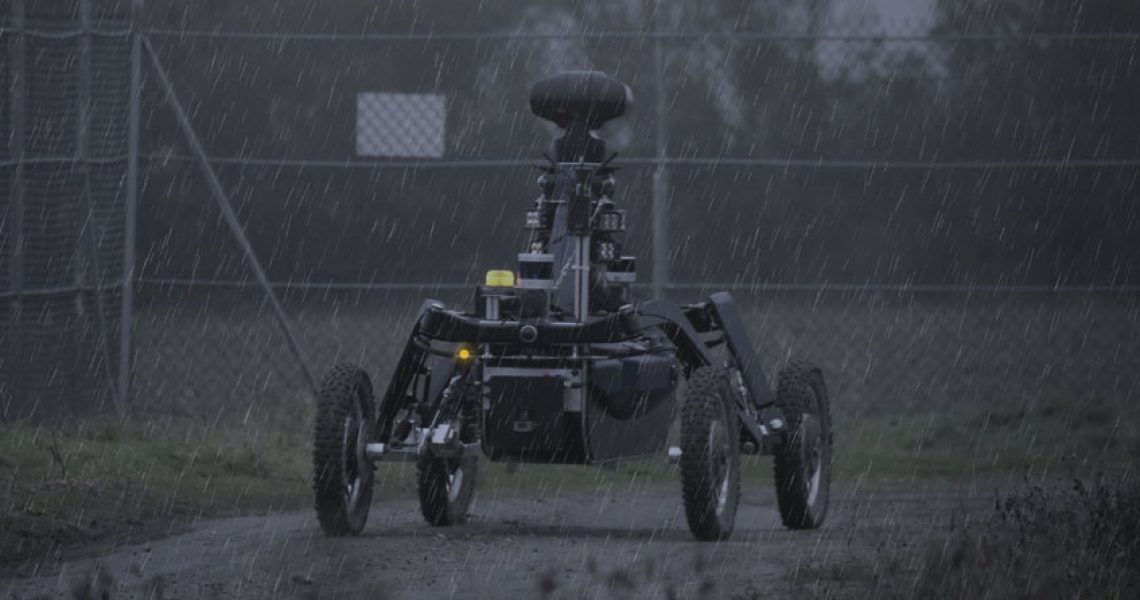
We shouldn’t think of it as an additional layer stacked on top of the others. That would be too simplistic. I prefer to see it as an additional ingredient that operates across multiple layers at once—and two recent experiences clearly illustrate why.
Let’s take the sensor layer. At most of the large sites where we’ve been called in to conduct audits, entire sections of the perimeter are covered by neither cameras nor radar, due to a lack of resources. Risks are increasing, but security budgets aren’t keeping pace. Security managers find themselves caught between a rock and a hard place: they know where their blind spots are, but cannot cover them with fixed installations. This is precisely where a mobile robot changes the game: rather than installing more cameras along kilometers of fencing, it patrols the uncovered areas and transforms a lack of surveillance into an intermittent but real presence.
The other example touches on the human layer, physical security, and security culture—and clearly illustrates why these three layers must be considered together. In Belgium, the head of security at an industrial site invited me to tour his facilities after noticing a spike in thefts. It was pouring rain (which is common in Belgium 😊). When we arrived at the guardhouse, the gate opened before we even had a chance to show our IDs. The guard, sheltered inside, didn’t want to go out in the rain to verify our identities. “You understand why I need a robot,” he told me, a little exasperated.
This scene alone sums up the fragility of a security system that relies on a single human link at any given moment. It wasn’t a bad officer, nor was it a flawed procedure on paper. It was a procedure that falls apart as soon as conditions become uncomfortable—and rain isn’t an exceptional scenario; it’s just an ordinary day in Belgium. A robot cannot replace an officer’s judgment, but it can take on the repetitive and tedious task of verification, regardless of weather conditions, so that humans can focus their attention on what they do best: making decisions.
These two stories are nothing out of the ordinary. That’s precisely why they’re so telling: they don’t describe rare vulnerabilities, but rather the trade-offs most sites make on a daily basis between budget, human comfort, and security requirements.
When it comes to cybersecurity, however, adding a robot means treating it like any other connected device, with the same requirements as the rest of the system.
And in terms of security culture, it forces the organization to clarify its procedures: what do we do when an alert is triggered? Who monitors it? Who makes the decision? Who takes action?
You need a network, not just layers
U.S. General Stanley McChrystal summed up a key lesson of modern operations with a now-famous phrase: “It takes a network to defeat a network.” In the same article, he explains that an effective network is not limited to transmitting data; it also relies on communication, physical and cultural proximity, a shared purpose, decision-making processes, personal relationships, and trust. (Foreign Policy)
The mille-feuille tells us how many layers are needed. McChrystal’s network tells us how they must interact. It’s not enough to simply stack resources; they must be organized into a network.
Cameras without procedures produce images. Sensors without operators produce noise. Agents without information work blindly. A robot without a mission doctrine becomes a technological curiosity. Conversely, when the layers communicate with one another, they become stronger than the sum of their parts.
I do not believe in absolute security. Good security does not promise that nothing will ever happen. It makes intrusion more difficult, slower, more visible, more costly, and more uncertain. Above all, it gives humans time to understand and decide.
That’s why the mille-feuille metaphor strikes me as apt. Strength doesn’t come from a single miraculous layer. It comes from the assembly. A single layer breaks easily. Several misaligned layers slide right past one another. But well-designed layers, well-connected and supported by a genuine culture of security, can transform an ordinary device into a robust system.
A robot like THALAMUS isn’t the whole cake. It isn’t even just one more layer. It’s an ingredient that, in certain environments, helps the layers connect, respond to one another, and hold together.