
By Renato Cudicio, MBA, President of Glocal Robotics
For a few minutes, forget your role as a security manager. Instead, imagine that your goal is to gain access to your own facility without being detected. You have only one question on your mind: where is the best opportunity?
If I were an intruder, here’s what I’d hope to find:
- areas that are never monitored;
- patrols with predictable schedules;
- fixed cameras with blind spots;
- times when no one is around;
- a security guard already occupied with another incident;
- poor visibility after dark.
If several of these situations sound familiar, rest assured: they’re generally not a sign of poor security management.
The real problem: risks are growing faster than budgets
For several years now, security managers have had to protect sites that are ever larger, more complex, and more sensitive. Risks are evolving, regulatory requirements are increasing, and infrastructure is expanding… but the budgets allocated to physical surveillance rarely keep pace.
The result isn’t a decline in team competence. It’s a growing imbalance between what needs to be monitored and the resources actually available.
No security manager deliberately chooses to create blind spots. They arise simply because it is impossible to be everywhere at all times. Most “gaps” in a security system reflect budgetary constraints rather than a lack of professionalism.
It is precisely this observation that explains the growing interest in autonomous security robots.
A robot is not a security guard. It is a presence multiplier.
One of the most widespread misconceptions is the belief that a robot is intended to replace all security guards.
That is not its role.
The human guard remains at the heart of the system. It is the human who analyzes the situation, makes decisions, and, if necessary, initiates an intervention or calls law enforcement.
The robot, on the other hand, plays a complementary role. It patrols tirelessly, detects anomalies, approaches suspicious incidents, observes, films, provides lighting if necessary, and immediately transmits the information to the remote monitoring center.
One could almost compare the robot to an extremely intelligent guard dog. It does not make decisions for its handler, but it sees, hears, and alerts much sooner than a human could on their own. Judgment, assessment of the event, and the decision to intervene always remain in the hands of an operator.
The best security is deterrence
When we talk about security, we often think of the ability to respond quickly.
However, the primary mission of a security system is to deter intrusion before it even occurs. An intruder is primarily looking for a favorable environment: minimal presence, minimal uncertainty, and enough time to act.
The introduction of an autonomous robot profoundly changes this equation.
Unlike a fixed camera, it moves.
Unlike a human patrol, it can patrol continuously, day and night.
Unlike a passive system, it can approach an alert, broadcast a voice message, illuminate an area, record events, and enable immediate remote operation.
But there is also a factor that is harder to measure: its psychological impact.
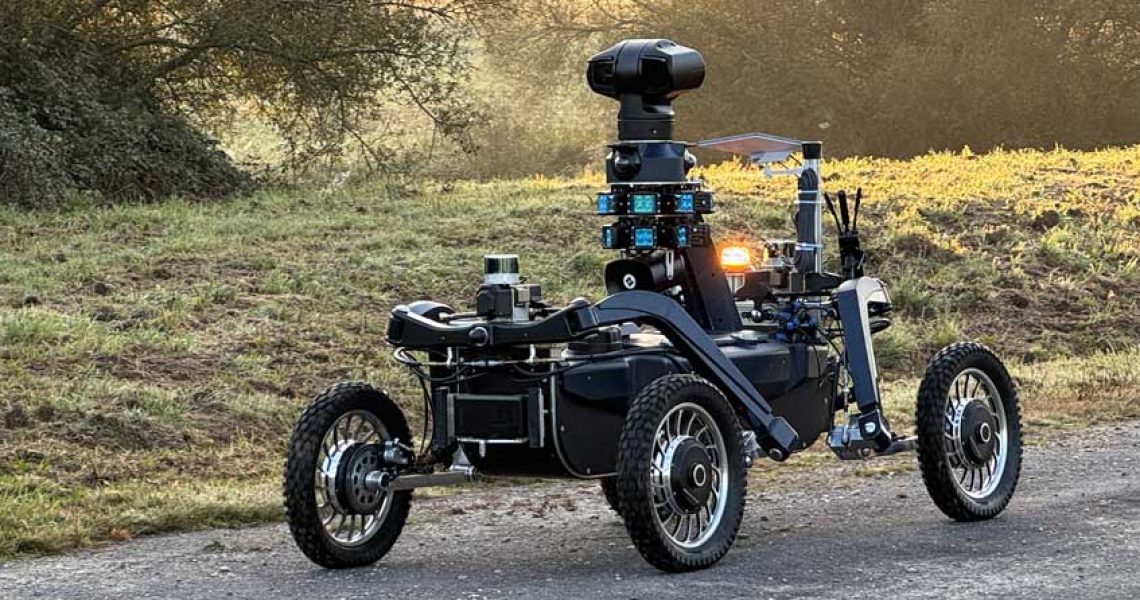
An imposing robot like THALAMUS does not go unnoticed. Its presence creates immediate uncertainty in the intruder: Have I already been detected? Am I being watched? Is someone taking control of the robot?
This hesitation is sometimes enough to thwart an intrusion attempt. When it comes to security, the best intervention is often the one that never needs to happen.
An effective robot isn’t deployed at random
Deploying a security robot isn’t simply a matter of placing it on a site and starting its first patrol. The first step is always a thorough analysis of the site. You have to look at the infrastructure… through the eyes of an intruder.
What are the most vulnerable access points? Which areas are inadequately covered? Where are foot patrols most difficult? When is surveillance at its weakest? Which routes would an intruder prefer?
The robot’s patrol scenarios are then designed to specifically complicate these intrusion scenarios. The robot does not replace fences or cameras. It reinforces the areas where these measures naturally reach their limits.
The Real Question
A security robot will never make a site impenetrable.
However, it can profoundly alter the calculations an intruder makes before taking action. The more difficult a site appears to penetrate, the higher the perceived risk of detection, and the more uncertain the intrusion scenarios become—the greater the likelihood that the intruder will give up.
Ultimately, an intruder does not fear a robot. They fear no longer knowing whether they are alone.
It is precisely this constant uncertainty—created by a mobile presence capable of detecting, observing, and alerting a human operator—that makes autonomous robots a new tool for perimeter security today.