
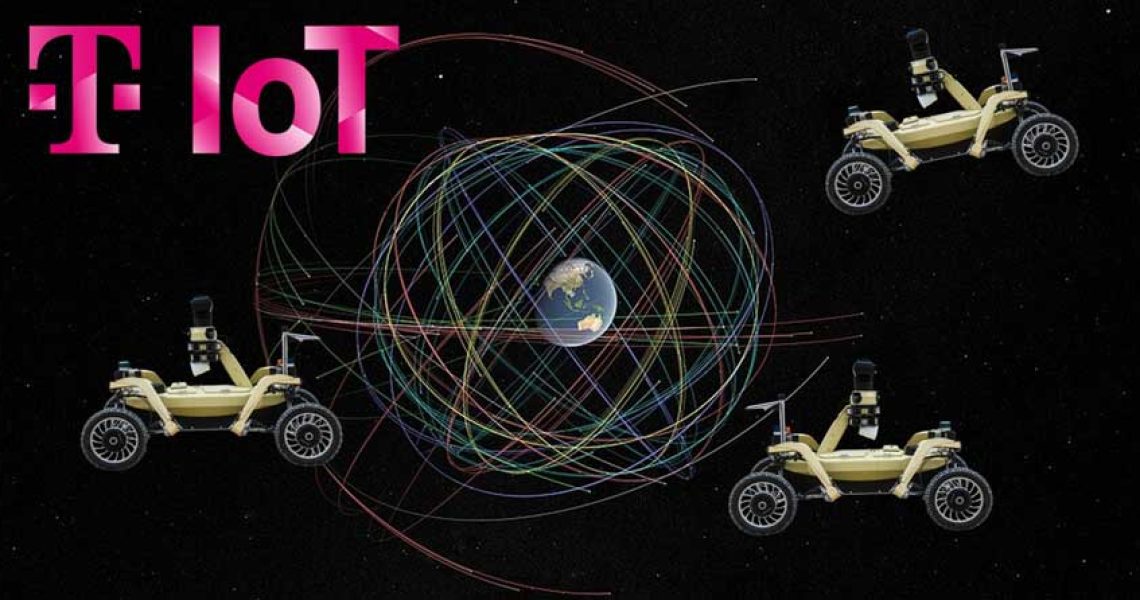
After six months of real-world testing, Glocal Robotics has chosen to integrate the high-precision GNSS positioning solution offered by Deutsche Telekom IoT into its robots. Combined with the Fixposition system already used on the THALAMUS, this technology provides a level of precision, stability, and reliability that is particularly well-suited to the demands of autonomous robotics.
Not all RTK networks are created equal
RTK technologies are not new. There are already various networks of reference stations capable of sending corrections to GNSS receivers to significantly improve the accuracy of conventional GPS.
But not all these networks are created equal. Glocal Robotics has used and tested several solutions of this type. They can deliver very good results, but their accuracy, availability, and—above all—the consistency of their data can vary depending on coverage, the density of reference stations, and operating conditions.
However, for an autonomous robot, obtaining a highly accurate position at a single point in time is not enough. What matters is having accurate, stable, and reliable information throughout the entire duration of a mission.
It is precisely on this point that the technology offered by Deutsche Telekom stood out during our trials. After six months of testing, we observed data quality and consistency superior to the more conventional RTK solutions we had used previously.
For an autonomous robot, knowing where it is located is not merely a matter of mapping. The quality of positioning directly affects navigation accuracy, adherence to trajectories, geotagging, the definition of safety zones, and the ability to consistently repeat a mission.
From Conventional GPS to High-Precision Positioning
The Precise Positioning solution offered by Deutsche Telekom is based on Swift Navigation’s Skylark technology.
It works by using data from numerous GNSS reference stations to model, in real time, the errors affecting satellite signals. The calculated corrections are then transmitted to GNSS receivers as a data stream.
The goal is not to replace GPS or Galileo, but to continuously correct the imperfections in the signals received by the robot.
This architecture is particularly valuable for autonomous robotics, as it enables much more precise positioning without necessarily having to install a dedicated local RTK station near each robot.
For an autonomous robot, even before deciding where to go, one condition remains fundamental: knowing exactly where it is.