
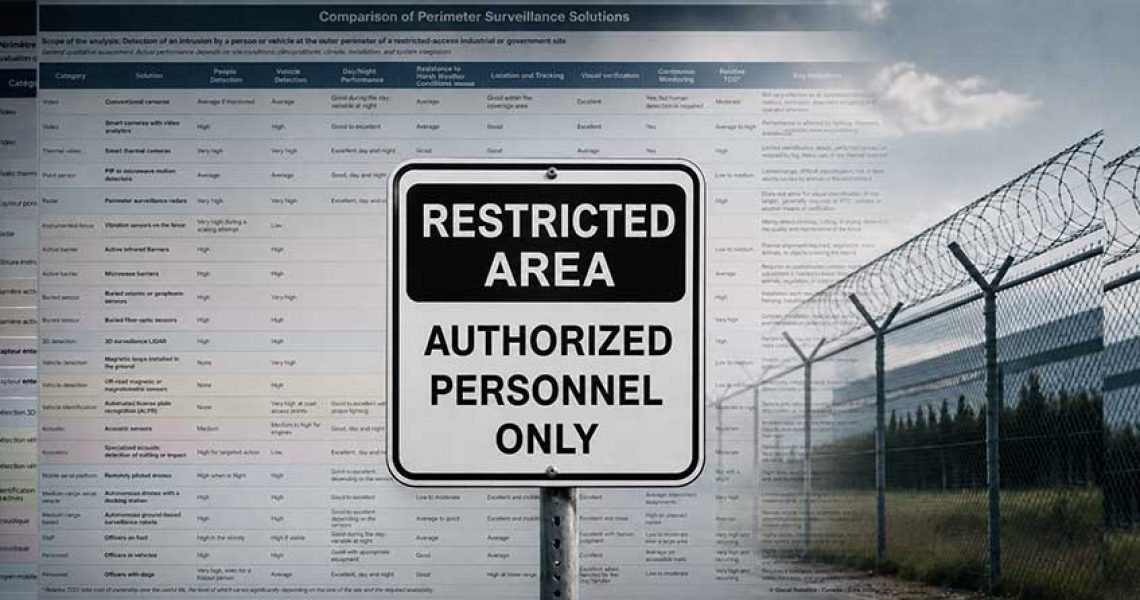
A comparison chart to help you choose the right solutions, understand their limitations, and build a system tailored to each site’s risks and budget.
By Renato Cudicio, MBA, President of Glocal Robotics
Smart cameras, radar, infrared barriers, buried sensors, drones, autonomous robots, and security guards on foot or in vehicles: there have never been so many perimeter surveillance solutions available.
However, simply adding more equipment does not necessarily guarantee better protection. An effective solution can become useless if it is poorly suited to the terrain, poorly integrated with other systems, or unable to trigger an effective response.
To help its clients structure this analysis, the Glocal Robotics team has decided to share the comparison grid it uses in its perimeter surveillance projects. More specifically, the comparison focuses on the detection of an intrusion by a person or vehicle at the outer perimeter of a restricted-access industrial, strategic, or government site.
This matrix was not designed to systematically identify a “winning” solution—nor to conclude that a robot is necessary in every case. Its purpose is to determine which combination of measures truly meets the site’s needs.
A Matrix for Asking the Right Questions
Our framework compares about twenty solutions and surveillance methods, ranging from conventional cameras to buried sensors, including radar, LiDAR systems, drones, ground robots, and human patrols.
In particular, it examines:
• the detection of people and vehicles;
• day and night performance;
• resistance to harsh weather conditions;
• localization and tracking capabilities;
• visual verification;
• continuity of surveillance;
• relative costs;
• constraints and key limitations of each solution.
This checklist does not claim to provide an automatic answer. Actual performance always depends on the terrain, climate, quality of installation, system integration, and operational procedures.
However, it does allow you to compare options on a common basis and avoid expecting a solution to perform a function for which it was not designed.
Start with the risks, not the available solutions
Detecting an anomaly and confirming an intrusion are two different functions. Some sensors are very effective at detecting passage or movement, but do not immediately indicate whether it is a person, an animal, an authorized vehicle, or a harmless event.
Before discussing cameras, radar, or robots, it is therefore necessary to examine the site.
Is it fenced in? Are there blind spots? Are certain areas difficult to access? Do you need to detect people, vehicles, or both? Are the weather conditions challenging? Does an alarm need to be visually confirmed? Is a response team available?
The answers directly guide the choice of tools.
A magnetic loop will effectively detect a vehicle, but not a person climbing over a fence. A camera will provide useful images, but may be limited by lighting, vegetation, or blind spots. Radar will locate a target at a great distance, but will generally need to be paired with a camera to confirm what has been detected. Each method addresses a specific part of the problem.
No single tool covers the entire security chain on its own
An effective system must be able to detect, locate, verify, analyze, and trigger the appropriate response.
A sensor installed on a fence can signal an attempted breach. Radar can track the target’s trajectory. A camera can confirm that the target is indeed a person. A robot can approach the area and transmit new images. Finally, an agent decides on the appropriate response.
The system’s performance therefore depends less on the number of devices installed than on how they complement each other, communicate, and integrate into operational procedures.
The remote monitoring center turns an alert into a decision
A sensor merely transmits information: a fence is vibrating, a person appears, a vehicle enters a zone, or unusual behavior is detected.
It is in the remote monitoring center that this information takes on its true value. Depending on the site’s organization, this function can be performed remotely by a remote monitoring center or locally by an on-site security control room. In both cases, agents assess the alert, review the footage, cross-reference multiple sources, evaluate the threat level, and coordinate the response.
Without this ability to analyze and make decisions, even a technically flawless detection risks becoming just another alarm in an already overloaded system.
An unmanned robot is not a complete security system
A robot can patrol autonomously, inspect remote areas, detect a person or vehicle, and transmit images without immediately exposing an agent to danger.
When a significant event is detected or a situation remains ambiguous, a person must be able to decide how to proceed: continue monitoring, reposition the cameras, modify the robot’s mission, dispatch an agent, or contact emergency services.
The robot therefore does not replace human judgment. It gives officers greater mobility, more information, and greater capacity for action.
One operator can supervise multiple robots
An operator does not need to continuously control each robot or constantly monitor all of its cameras.
The robots carry out their patrols autonomously and only alert the operator when an event requires their attention.
In certain configurations, a single operator can thus supervise multiple robots simultaneously—potentially up to ten when missions are stable, alerts are infrequent, and procedures are well-structured.
However, this ratio is not a universal rule. It must be determined based on the number of alerts, the complexity of the missions, the level of risk, and the time required to handle each event.
But the principle is key: autonomy allows the operator to focus their attention where their judgment is truly needed.
Compare the Total Cost of Ownership
Total cost of ownership must be assessed over the entire lifespan of the system. It includes, in particular, purchase or lease, installation, integration, telecommunications, maintenance, licenses, monitoring, and alert handling.
A solution that is inexpensive to purchase may have a high TCO if it requires significant work, generates numerous false alarms, or constantly ties up an operator. Conversely, a higher monthly service fee can reduce the need for physical patrols, improve coverage, and enable existing agents to monitor a site more effectively.
The proper comparison, therefore, involves measuring the TCO required to achieve a given level of security.
Surveillance solutions must augment human judgment
Perimeter security cannot rely solely on automation. When a situation is ambiguous, sensitive, or urgent, a person must understand the context, assess the consequences, and make the decision.
The role of surveillance solutions is therefore less about removing humans from the process than about directing their attention toward the events that truly matter.
A conventional camera transmits images. A camera equipped with video analytics flags a relevant situation. An autonomous robot patrols, collects information, and alerts the operator when human analysis is needed.
Without artificial intelligence, cameras, sensors, and robots can primarily increase the volume of information that needs to be monitored. With properly configured artificial intelligence, they filter, prioritize, and contextualize this information.
The true multiplier effect comes from this combination: intelligent machines capable of continuous monitoring and agents capable of understanding, deciding, and acting.
Glocal Robotics makes this comparative chart available to security managers, system integrators, and site operators who wish to structure their analysis. It can serve as a starting point for a more detailed study that takes into account the specific environment, risks, response procedures, and available human resources.