
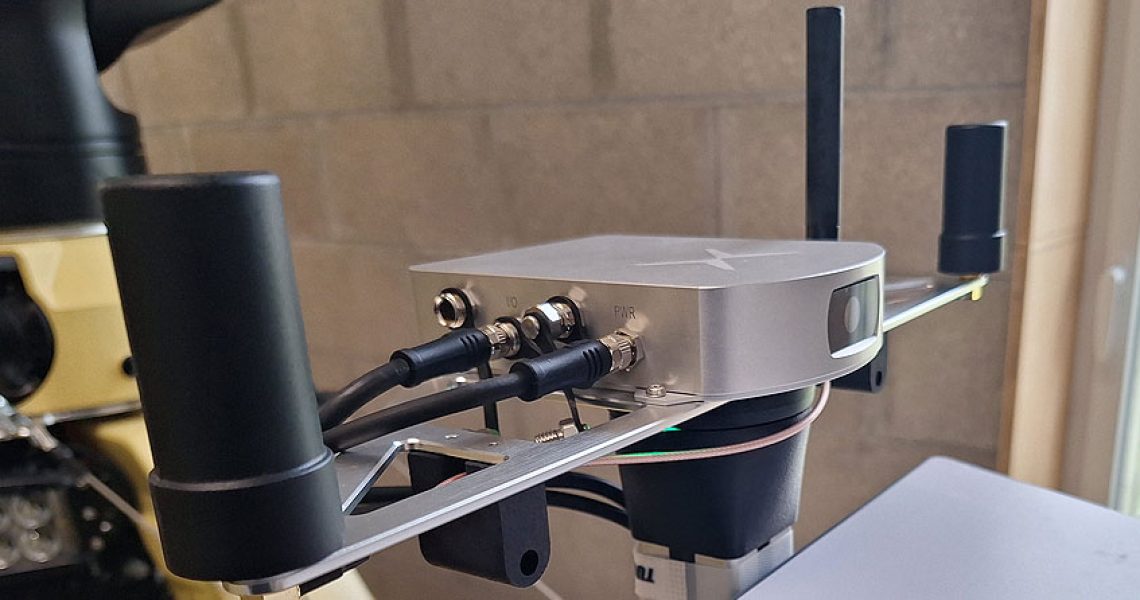
At Glocal Robotics, the design of the THALAMUS robot has always been guided by a key objective: to provide reliable and robust navigation in complex environments, specifically for site security and surveillance missions.
However, as deployments have progressed, a well-known reality in the field has become apparent: even with advanced GNSS technologies, very slight variations in position can occur during navigation. These phenomena do not compromise the robot’s overall reliability, but they can become significant in certain use cases where precision must be extremely high.
It is in response to these heightened demands that the THALAMUS 2026 models now incorporate positioning technology developed by the Swiss company Fixposition.
The reality on the ground: already high precision, but sometimes room for improvement
Current navigation systems allow the THALAMUS to operate with a high level of reliability in a variety of environments. However, the inherent limitations of GPS—particularly in the presence of structures, obstacles, or during transitions between open and covered areas—can cause a slight drift over the course of movement.
In most situations, this drift remains imperceptible in the overall execution of missions. However, it can become significant in very specific cases, particularly when the robot must navigate narrow passages or operate with very tight margins.
In these scenarios, a few dozen centimeters can be enough to make a passage more difficult, or even inaccessible without adjustment.
Sensor fusion for a perfectly controlled trajectory
Fixposition technology is based on an advanced multi-sensor fusion approach. It combines data from high-precision GNSS, onboard vision, inertial sensors, and the robot’s odometry in real time.
What makes the difference is the complementary nature of these sources. When the GNSS signal becomes less reliable, the other sensors take over to maintain a consistent and continuous position estimate. This continuity significantly limits the effects of drift and maintains a stable trajectory, even in constrained environments.
Critical precision for site security
In security missions, the THALAMUS must operate in close proximity to infrastructure, navigate complex areas, and follow strictly defined routes.
The ability to maintain a precise trajectory is essential, not only for the quality of surveillance but also to ensure smooth movement.
By reducing deviations caused by drift, the integration of Fixposition allows the robot to navigate narrow passages more easily, follow its paths with greater consistency, and move with better control of its immediate environment.
Essential continuity for surveillance missions
In surveillance missions, the consistency of movement is a key factor. A robot must be able to reproduce its routes with precision, consistently over time, and without unpredictable variations.
Thanks to Fixposition, THALAMUS maintains stable and continuous trajectories, which facilitates supervision, patrol analysis, and mission repeatability. This stability enhances the overall reliability of the surveillance system and enables better utilization of operational data.
A critical challenge in defense applications
In defense contexts, the precision and continuity of positioning take on an even more strategic dimension. Environments can be complex, conditions variable, and operational constraints high.
The integration of Fixposition enables THALAMUS to maintain a reliable estimate of its position, even under degraded conditions. The robot thus retains its ability to follow precise trajectories and navigate consistently, even in demanding areas.
Toward increasingly sophisticated automated surveillance
With this advancement, THALAMUS enhances its ability to meet the demands of sensitive sites and operational environments. By combining robustness, continuity, and precision, it enables surveillance missions to be carried out with an even higher level of control. In contexts where precise movement control is essential, this added precision brings a new dimension to autonomous security robotics.