
By Renato Cudicio, MBA, President of Glocal Robotics
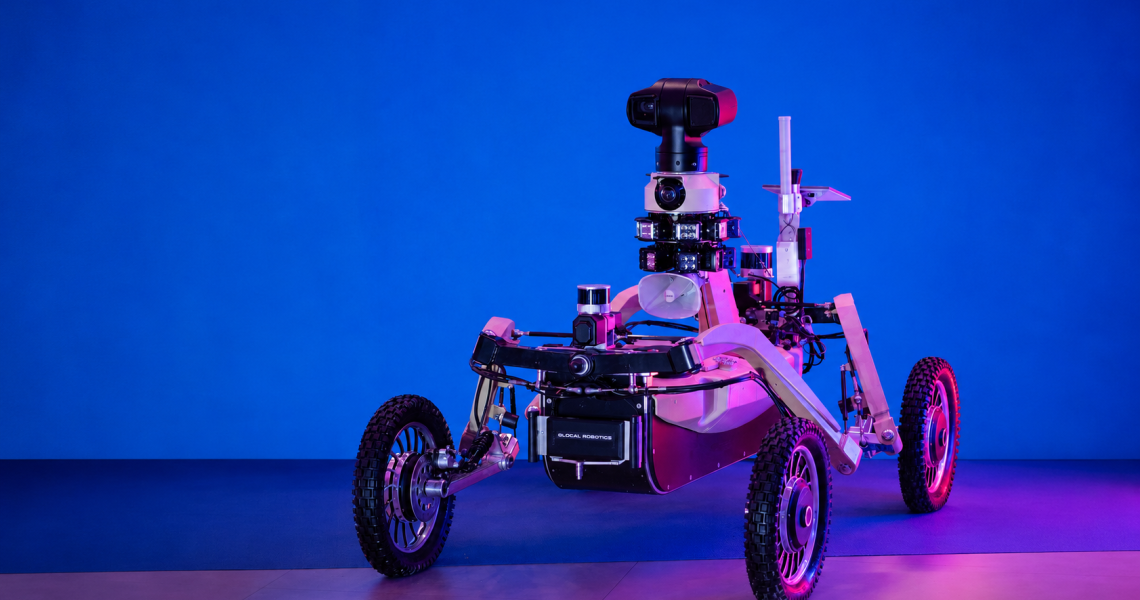
The arrival of THALAMUS robot in North America is bound to spark curiosity. That’s only natural. An autonomous security robot catches the eye, raises questions, and elicits reactions ranging from enthusiasm to skepticism. Since its arrival in Quebec, THALAMUS is entering a new phase: adapting to the demands of the North American market and Canadian conditions.
But the first question should never be, “How much does a robot cost?”
The right question is rather, “Do we have a security problem for which a robot is actually relevant?”
Because let’s be clear: an autonomous security robot isn’t useful everywhere. It does not replace a security strategy. It cannot, on its own, fix a poorly designed site, a missing procedure, or a failing security culture. On the other hand, in certain environments, it can become an extremely powerful tool: a mobile extension of the surveillance center’s eyes, support for security officers, a deterrent presence, a means of resolving uncertainties, and a way to make patrols less predictable.
Here are ten simple questions to help you determine whether a robot like THALAMUS is worth considering.
1. Is your site large enough that human surveillance would quickly reach its limits?
A small, compact site that is well-lit, fully visible from a few cameras, and easy to cover on foot probably does not need an autonomous robot.
The situation changes when the site is large, sprawling, irregular, difficult to cover, or takes too long to patrol. At one of our clients’ sites, the patrol route configured for THALAMUS covers 16 km. An officer in a car, with all headlights on, takes an hour and a half to complete the route—so they can only do it once per night. The robot, on the other hand, takes two and a half hours, but repeats the route three times in the same night, alternating between lit and unlit sections. Three variable passes versus a single predictable pass: the difference in coverage is not marginal; it completely changes the nature of the surveillance.
This is not about replacing the officer. It’s about giving them an additional means of maintaining a presence.
2. Does your site have a reason to attract unauthorized individuals?
Not all sites present the same level of interest to an intruder.
A site containing vehicles, metals, fuel, expensive equipment, sensitive data, construction materials, critical infrastructure, or strategic facilities is not like any other site. Some sites attract theft. Others attract espionage, sabotage, curiosity, protest, or simply opportunism.
And a site’s appeal doesn’t always come from where you might think. At one of our clients’ sites, the property contains hazardous industrial waste—but also a pond teeming with fish. The intrusions weren’t caused by spies or metal thieves: they were fishermen who climbed over the fence to go fly-fishing, without having the slightest idea of the real danger they were facing. The risk we anticipate isn’t always the one that materializes.
The more a site has to lose—or to cause someone else to lose—the more seriously security must be planned.
3. Is the perimeter clearly defined?
A security robot works best when the area to be monitored is clearly defined.
A fence, gates, traffic routes, restricted areas, designated access points, and clear signage provide structure to the security system. The robot doesn’t need a perfect site, but it does need an environment that is understandable, mappable, and consistent.
This implies a non-negotiable condition: the site must be closed to the public during the robot’s patrols. A site where “tourists” can move about freely while an autonomous robot is patrolling is not a suitable environment—not because of the robot itself, but because the distinction between authorized and suspicious presence becomes impossible to determine, for both humans and machines.
If the perimeter isn’t clear to humans, it will rarely be clear to technology.
4. Are there blind spots?
That’s often where the problems begin.
A fixed camera sees very well what it’s pointed at. The problem is everything else: the blind spot behind a building, the end of a fence, a poorly lit area, the back of a warehouse, a remote parking lot, a service road, or a container placed in the wrong spot.
An autonomous robot becomes valuable when it can go and check places that fixed cameras don’t always see.
5. Are there long periods without patrols?
Security is often at stake at night, on weekends, on holidays, during shift changes, or in those gray areas where everyone assumes someone else is keeping watch.
If certain areas go unpatrolled for long periods, the risk increases. Not just because an intruder can get in, but because they can take their time.
A robot can reduce these windows of inattention. It can repeat, vary its route, wait, return, and double-check. It doesn’t get cold. It doesn’t get bored. It isn’t tempted to cut a patrol short just because nothing has happened in three weeks.
6. Are your patrols too predictable?
A patrol that’s too regular sometimes reassures the organization more than it does the site itself.
If a malicious individual can observe patterns, figure out schedules, identify routes, and anticipate absences, the patrol becomes less effective. It still exists, but it loses some of its effectiveness.
A robot allows for varied scenarios: visible patrols, silent patrols, extended stops in sensitive areas, random passes, post-alert checks, and presence in rarely visited sectors. This unpredictability has real operational value.
7. Do you already have cameras, radars, or detectors, but too few resources to resolve uncertainties?
Many sites today are well-equipped with detection systems but lack the means to verify findings.
An alarm goes off. A camera captures something. A radar detects movement. But what happens next? Who is watching? Who understands what’s happening? Who responds? How long does it take to determine whether it’s an animal, a late employee, an intruder, a vehicle, or simply a false positive?
This issue took on particular significance following the theft at the Louvre in October 2025. A security official recently explained to us that, in this kind of situation, management’s top priority is now the safety of their own staff. In practical terms, this means it’s no longer an option to send a security guard alone to investigate an ongoing intrusion: the directive is to immediately alert law enforcement rather than put an employee at risk. The problem is the time it takes for law enforcement to arrive on the scene—which is often more than enough time for the intruders to have already fled.
This is precisely where a robot like THALAMUS comes into its own: it can quickly reach the scene without putting an officer in danger, serve as the eyes of security personnel in real time, and, ideally, scare off intruders by its mere presence before they even have time to commit an offence.
8. Do you have a remote monitoring center or a team capable of analyzing the footage?
An autonomous robot should not be a standalone entity.
It must be part of a decision-making chain: detection, movement, verification, transmission, analysis, decision, and intervention. This requires that a remote monitoring center, a security team, or designated personnel be able to receive the information, understand it, and take action.
Without an operator, without procedures, and without a clear escalation process, even the best robot risks becoming nothing more than a fancy machine that sends images to no one.
9. Are your agents being used for repetitive, low-value-added tasks?
Let’s be honest: a large part of security work consists of repeating the same patrols, checking the same fences, walking the same paths, and finding that nothing has happened.
This work is necessary, but it wears down teams. It consumes time, attention, and sometimes physical stamina under difficult conditions: cold, heat, rain, darkness, isolation, and long distances.
A robot is useful when it frees agents from some of this repetition, allowing them to focus on what humans do best: assessing, deciding, intervening, and communicating.
10. Is your organization ready to integrate a robot into its security culture?
This is probably the most important question.
Buying or renting a robot is a technical decision. Integrating it is an organizational decision. You must define missions, scenarios, responsibilities, schedules, responses to alerts, cybersecurity rules, maintenance procedures, and success criteria.
A robot does not replace security culture. It puts it to the test. It forces the organization to answer simple, yet often overlooked, questions: What do we really want to monitor? When? Why? Who decides when there’s an anomaly? What do we do with the information we receive?
So, do you need a robot?
This checklist isn’t scientific. It’s deliberately pragmatic.
If you answer “yes” to two or three questions, a robot is probably not your immediate priority. It might be better to first improve procedures, lighting, cameras, access control, or training.
If you answer “yes” to five or six questions, the discussion becomes serious. There’s likely an issue with coverage, presence, resolving doubts, or operational efficiency.
If you answer “yes” to seven or more questions, then an autonomous security robot is clearly worth evaluating.
The arrival of THALAMUS in North America doesn’t mean that every site needs to automate with robots.
That would be absurd. Rather, it means that a new option is becoming available for sites facing real challenges related to surveillance, distance, repetitive tasks, deterrence, and integration.
A robot like THALAMUS isn’t for everyone. But for sites that truly need it, it can profoundly change the way we think about security.