
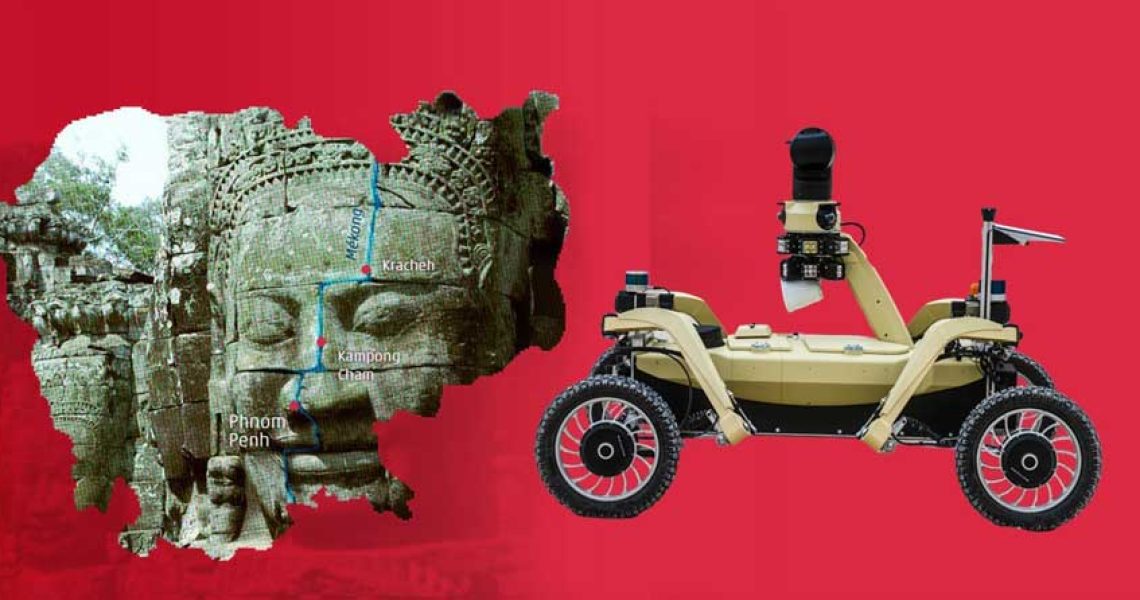
By Renato Cudicio, MBA, President of Glocal Robotics
In 1992, I had the opportunity to participate in what was then the largest United Nations mission in Cambodia. I was young and full of enthusiasm, and that experience left a lasting impression on me that has never faded. There, on the ground, I saw an organization that was imperfect—like all human organizations—but one that embodied values that resonated with me. Respect for the individual. The belief that we can rebuild. The conviction that a shared framework is better than every man for himself.
Thirty years later, these values are still my own. And I find them, effortlessly, reflected in the values of my companies.
That is why Glocal Robotics has decided to support the initiatives of the United Nations Global Compact and to join its SPARK program. We are now among the approximately 6,500 companies worldwide aiming for certification by the end of 2026. I want to make this clear: this is not just a box to check or an obligation we’re forced to fulfill. It’s a philosophical and strategic decision. I’m making it because I believe in it, and because I think that, in the turbulent times we’re living in, every company must do its part—on its own scale, with its own resources.
The United Nations Global Compact, in a nutshell
The Global Compact is the world’s largest corporate responsibility initiative. Launched at the turn of the 2000s, it is voluntary: no law requires a company to join. It is based on ten universal principles, grouped into four areas—human rights, labor standards, the environment, and anti-corruption—and is aligned with the Sustainable Development Goals.
The idea is simple: a company that aligns its strategy and operations with these principles does more than just “look good.” It builds something stronger, more sustainable, and more trustworthy. And in my line of work, trust isn’t just a nice-to-have. It’s the heart of the product.
SPARK: A Clear Roadmap Rather Than a Vague Mandate
The common criticism leveled at this type of approach is that it’s vague. We’re told to be “responsible,” “sustainable,” and “exemplary,” without ever being told where to start. SPARK directly addresses this objection.
It’s a three-month learning program designed by the Global Compact for SMEs and suppliers who want to strengthen their practices without overhauling everything overnight. In practical terms: online modules, sessions led by experts, tools that can be directly applied to the business, and about ten hours of work to be completed at your own pace. The entire program is structured around three pillars—environment, social, and governance—built on the foundation of the ten principles.
We aren’t expected to solve everything all at once. We’re asked to have a clear plan and stick to it. This approach resonates with me because it’s exactly the one I apply to engineering: you can only truly master something if you break it down methodically.
How does this change things when building a robot?
One might think that such a program mainly concerns large industrial chains or consumer goods companies. That is a misconception. Building an autonomous security robot like THALAMUS means bringing together, in a single machine, just about all the issues that SPARK raises.
A robot is energy—the energy consumed on the factory floor, the energy the machine expends while patrolling day and night. It is a supply chain—dozens of components, sourced from all over the world, each with its own social and environmental history. It is a team—women and men who design, assemble, and test the robot under conditions that must be safe. And it’s a system that collects sensitive data, for which we must be accountable.
In other words, responsibility isn’t separate from the product. It’s embedded in the product.
Three Pillars, Concrete Actions
Here’s what we’re committed to doing in practice for each of SPARK’s three pillars—not just in theory, but in the reality of a company that builds robots.
The Environment. Start by measuring the energy footprint of our workshop and our assembly processes, because you can only reduce what you measure. Next, we’ll push for eco-design: a modular, repairable, and upgradeable robot needs to be replaced less often than a disposable product—that’s good for the planet, and it’s also, I’ll admit, a case for industrial resilience. We’ll optimize the machine’s own energy autonomy: batteries, recharge cycles, patrol routes—all of these factors impact operational energy consumption. And plan for end-of-life from the outset: batteries, circuit boards, waste—none of this should end up in random landfills.
Social considerations. Occupational health and safety are non-negotiable when handling batteries, mechanical parts, and mobile platforms under testing. Train and develop the team’s skills, because a high-tech company is only as good as the people who make it up. We must require our suppliers to uphold decent working conditions as well. And we must never lose sight of the robot’s social purpose: THALAMUS exists to take on the tasks that workers no longer want to do, no longer know how to do, or should no longer be doing—not to replace humans, but to free them from what wears them down.
Governance. This is probably the area where we have the least ground to cover, because many of these principles are already embedded in the way we work. A code of conduct, a clear anti-corruption policy, and straightforward rules with our partners: the foundation is in place. But above all, we have long made supply chain transparency, component traceability, and data protection by design central priorities. Readers of this blog will recognize here what I regularly advocate under the concepts of hardware and software bill of materials, chain of trust, and data sovereignty. In this regard, SPARK does not require us to change course: above all, it allows us to structure, document, and enshrine within a recognized framework the convictions and practices we were already applying—the very same ones that lead us to comply with Level 1 of the PCCC and to work toward Level 2.
A cost today, a discipline that pays off tomorrow
Let’s be honest, because vague generalizations don’t do anyone any favors: adopting these new ways of doing things comes with a short-term cost, since change itself requires significant effort. But it’s an investment, and the return can come very quickly. And besides, measuring progress is already a step toward improvement. Every kilowatt-hour, every piece of waste, every step we document eventually reveals an inefficiency we were unaware of. The rigor required by SPARK doesn’t slow us down—it forces us to be better. And a more efficient company is, in the medium term, a more profitable company. Today’s cost is tomorrow’s savings.
Furthermore, this standard benefits the community in which we live—and, market after market, it is becoming a criterion valued—if not outright required—by clients. In critical infrastructure, defense, and public procurement, a supplier’s accountability and traceability are becoming prerequisites for entry. Those who prepare for this today will not, tomorrow, face a transformation they chose to undertake too late.
My Takeaway
If I had to sum up our commitment, I’d do so in one sentence: Building a trustworthy machine and building a trustworthy company are one and the same.
THALAMUS monitors sensitive sites because its clients trust it. We owe this trust to our mastery of our technology, but also to the way we manufacture, the way we treat our people, the way we choose our suppliers, and the way we respect the environment that hosts us. SPARK and the Global Compact ask nothing of us that is unrelated to this. They ask us to do it better, to prove it, and to stick to it.
At its core, it’s the same thread that runs all the way back to Cambodia: the idea that a common framework is better than every man for himself, and that a company, like a person, is judged as much by what it produces as by how it produces it.