
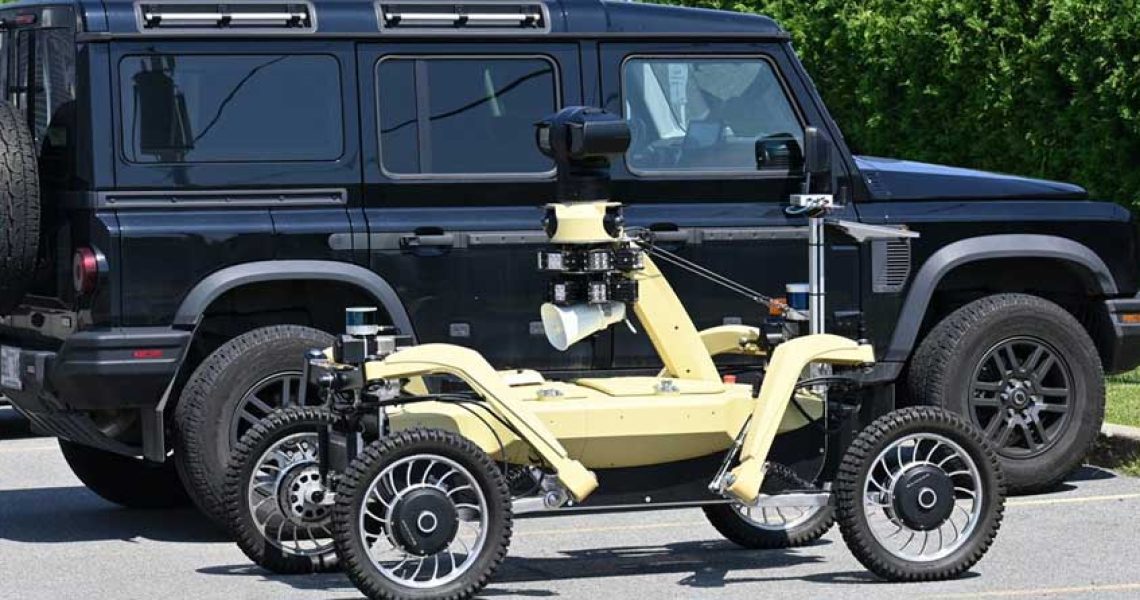
Glocal Robotics has reached an important milestone. Our company has successfully entered into a Supply Arrangement as part of the Defence Drone Initiative Marketplace (DDIM) of the Department of National Defence of Canada. With our autonomous robot THALAMUS, Glocal Robotics has been selected as a prequalified supplier under the DDIM—a recognition that aligns with the Canadian Army’s MINERVA initiative, which aims to develop autonomous systems as closely as possible to real operational needs on the ground.
Let’s be clear from the outset: this is a prequalification under the Supply Arrangement. It does not mean that Glocal Robotics has been awarded a contract, nor that it has been selected for a specific procurement opportunity.
What this prequalification does open up for us, however, is crucial: the opportunity to work and test our systems in a real operational environment, to understand the concrete constraints on the ground, and to engage directly with the people who will be using the technology we’re developing.
THALAMUS: The Foundations of a Dual-Use Platform
If this prequalification means so much to us, it’s because THALAMUS was designed from the start as a scalable platform. Beyond its primary purpose, the robot has the technological foundations—autonomous architecture, perception capability, and payload modularity—to become a dual-use machine, able to shift toward surveillance and reconnaissance missions. This is exactly the kind of versatility the Canadian Army’s challenges are looking for, and it is on this ground that we intend to demonstrate the value of THALAMUS.
An Approach Worth Attention
This prequalification is part of a broader movement. The battlefield is changing: the proliferation of sensors, drones, and precision weapons is accelerating a shift toward autonomous systems, which are designed to assist—and sometimes even replace—human operators in the most dangerous environments. This is the shift MINERVA sets out to address.
What sets MINERVA apart is not just the autonomous systems that might result from it—it’s the method. Rather than drafting specifications from a distance, the Army brought industry representatives out into the field. During events held at Canadian Forces Base Valcartier (August 10) and Garrison Petawawa (August 19), soldiers put into practice scenarios based on real-world challenges they face. At Valcartier, the 12e Régiment blindé du Canada (12 RBC) developed scenarios focused on surveillance and reconnaissance, while units from the 35th Canadian Brigade Group and the Arctic Response Company Group demonstrated equipment and operations in Arctic conditions. At Petawawa, the demonstration focused on intelligence, surveillance, reconnaissance, casualty evacuation, and logistical support. A final session, dedicated to the management of shared airspace, is scheduled to take place at CFB Gagetown in late September.
The goal remains the same throughout: to show potential partners, plainly, the concrete challenges that need to be addressed, and to strengthen the connection between those who design the technology and those who will use it. This is a way to build capabilities that hold up in combat, while strengthening national supply chains and reducing dependence on foreign inputs.
Six Challenges, from the Arctic to the Front Lines
Led by the Canadian Army with support from Innovation, Science and Economic Development Canada, MINERVA launched six challenges this summer designed to address specific operational gaps using innovative autonomous systems:
- an uncrewed air system for the Arctic;
- aerial intelligence, surveillance, and reconnaissance;
- airspace deconfliction for uncrewed systems;
- an uncrewed air system for dropping cargo and munitions;
- an uncrewed ground system for surveillance and reconnaissance;
- an uncrewed ground system for tactical transport.
These challenges are open for submission under the Innovative Solutions Canada program, which connects federal departments with Canadian companies, offering up to $2.5 million per challenge to develop, test, and commercialize the selected technologies.
Why This Matters
This is precisely the spirit of MINERVA, and it is what drives us. You can’t design a useful autonomous system from a desk. You design it by experiencing firsthand the cold, the mud, the fatigue, and the tactical demands of those who will be using it in the field.